The most common reason content doesn't get found is structural, not qualitative. The content may be excellent — but if it's organized around topics rather than questions, search systems can't connect it to the people asking those questions.
Search engines and AI tools are question-answering systems.[1] When someone types a query, the system looks for the clearest, most specific answer to that exact question. Content organized around broad topics ('My thoughts on leadership,' 'Why culture matters') doesn't match the specificity of real search queries.[2] Content organized around questions ('Why do high-performing teams still fail?' 'What does a healthy team culture actually look like?') matches directly. The fix is not to create more content — it is to reframe existing content around the questions your clients are actually asking.[3]
Start by auditing your existing content. For each piece, ask: what specific question does this answer? If you can't answer that in one sentence, the content is probably too broad to be discoverable. Reframe the title as a question. Restructure the opening paragraph to answer that question directly. Publish it as a dedicated page, not a blog post buried in a feed. That single structural change — topic to question — is the most impactful improvement most experts can make.
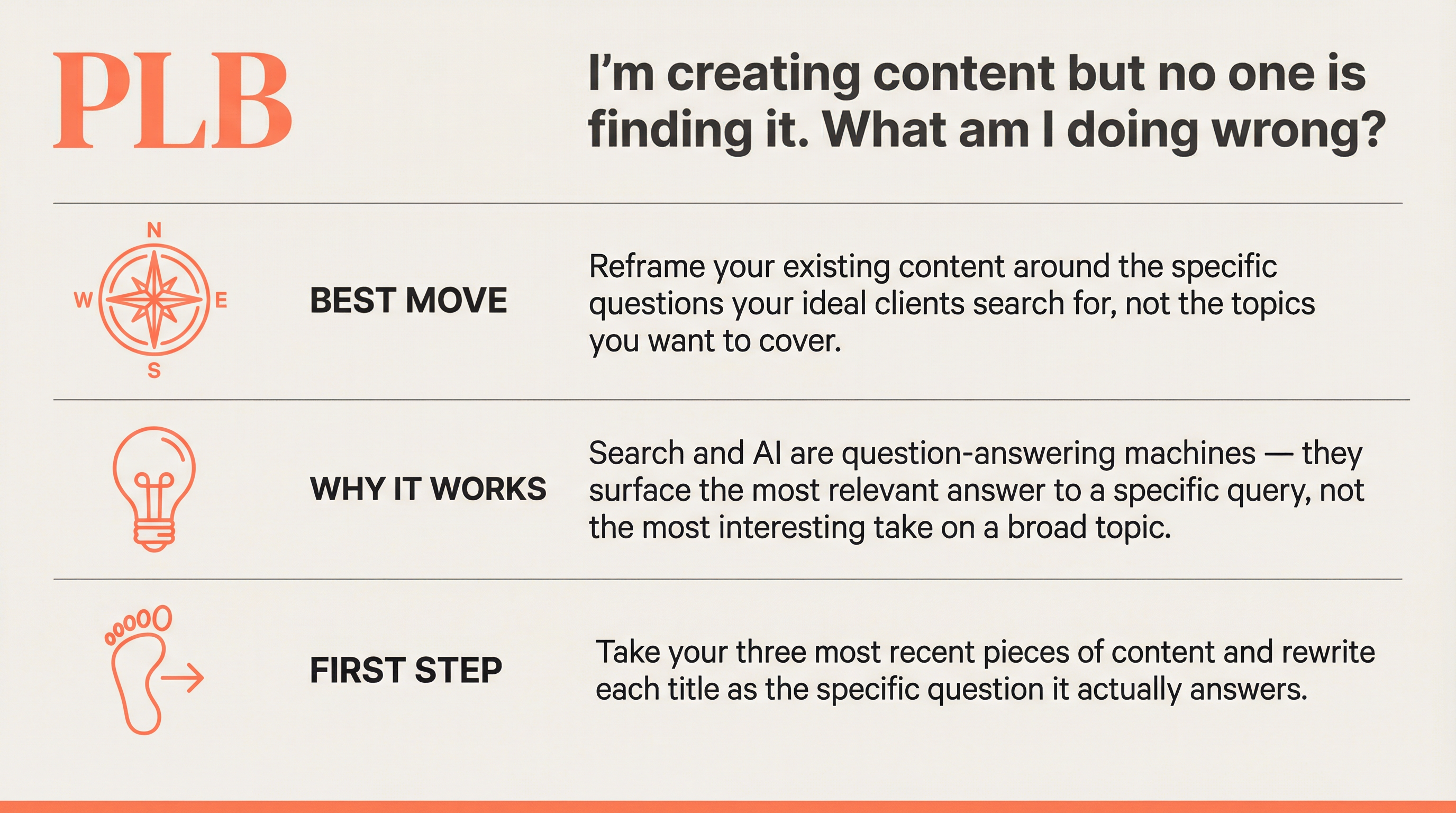
- Content organized around topics is rarely discoverable; content organized around questions is.
- Search engines and AI systems match queries to answers — specificity is the mechanism.
- The fix for undiscovered content is usually structural, not qualitative — the content is good, but the framing is wrong.
- Reframing a title as a question is the single highest-leverage edit most experts can make to existing content.
- A dedicated page that answers one question clearly will outperform a long blog post that covers many topics loosely.
- Content discoverability is not about volume — five well-structured question-based pages outperform fifty topic-based posts.

See how AI understands your expertise
The AI Alignment Reading reveals where you are visible, where you are missing, and what to fix first.
Get Your AI Alignment ReadingHow do I find out what questions my ideal clients are actually searching for?
The most reliable source is your own client history — not keyword tools. What questions did your best clients ask before they hired you? What problems did they describe in their first email or discovery call? What misconceptions did you have to correct in the first session? These are the real search queries, because they came from real people with real problems. Keyword tools like Google's 'People also ask' and AnswerThePublic are useful supplements — type the beginning of a question your clients ask and observe the autocomplete suggestions, which reflect actual search behavior. But the most important step is to go back through your last ten client onboarding conversations and write down every question that came up before the engagement started. Those questions are your content roadmap.
Is there a difference between how Google and AI tools find content?
The underlying goal is the same — surface the most relevant answer to a specific query — but the mechanics differ in ways that matter for how you structure content. Google uses links, authority signals, and keyword matching to rank pages. AI tools like ChatGPT and Perplexity analyze the content itself: they look for clarity, specificity, and coherent reasoning, and they synthesize across multiple sources rather than ranking a single winner. This means that for AI-driven search, being the clearest answer on a topic matters more than being the most linked-to page. A well-structured, thoroughly reasoned page that answers a specific question will be cited by AI systems even if it has no inbound links — which is a significant opportunity for experts who are building a knowledge base from scratch.
What's the difference between a blog post and a question-based page?
A blog post is organized around a topic, written in a narrative or opinion format, and published in reverse chronological order in a feed — designed to be read in the moment it's published. A question-based page is organized around one specific question, written to answer that question as directly and completely as possible, and published as a permanent, standalone page with its own URL — designed to be found when someone searches for that question, months or years after it was written. The structural difference is significant. Blog posts are ephemeral: they're visible when published and invisible a week later. Question-based pages are compounding: they continue attracting the right people every time someone searches for that question. Most expert websites have many blog posts and no question-based pages — which is why most expert websites generate no organic traffic.
Do I need to delete my old topic-based content, or can I repurpose it?
Repurpose first — most topic-based content contains the raw material for several question-based pages. A post titled 'My thoughts on pricing' likely contains answers to 'How do I price my services without undercharging?', 'What's the difference between value-based and hourly pricing?', and 'How do I raise my prices without losing clients?' — three separate discoverable pages. The process is: read the original post, identify every distinct question it implicitly answers, extract the relevant content for each, reframe each as a standalone question-based page with a direct opening paragraph. You can leave the original post in place or redirect it to the new pages. The goal is not to delete your archive — it is to restructure it around the questions that make it findable.
How many question-based pages do I need before I start seeing results?
Five well-structured pages that answer the five most common questions your ideal clients ask before they hire you is a viable starting point — and it will outperform most expert websites that have been publishing for years. The compounding effect accelerates as you add more pages, because each new page adds to the authority of the whole and the interconnections between pages signal to search systems that you have a coherent body of expertise, not just isolated answers. The key is specificity: one page that clearly and completely answers a real question will outperform ten pages that loosely address a broad topic. Start with five, publish them as standalone pages with direct opening paragraphs, and add new ones as new questions emerge from client conversations.
The content discoverability problem is almost never a quality problem — it is a structure problem.[2] Experts who feel invisible online are usually producing genuinely valuable ideas, but organizing them in a way that search systems cannot parse. The shift from topic-based to question-based content is not a stylistic change; it is an architectural one. It changes the fundamental relationship between your expertise and the people who need it.
The most efficient implementation is an authority directory: a structured collection of pages on your own website, each answering one specific question your ideal client asks. The pages accumulate into a body of expertise that is findable, citable, and compounding.[1] Unlike a blog or social feed, it doesn't reset — every page you publish continues working indefinitely.
This is exactly what we help our clients do at Perfect Little Business.

Founder, Perfect Little Business
Cindy Anne Molchany is the founder of Perfect Little Business. Since 2015, she has designed and built over 70 online programs for clients that have collectively generated more than $100 million in revenue. She helps established expert founders build intelligent, human-first businesses that attract ideal clients, command authority, and create leverage — without performing for algorithms or chasing endless scale.