You grow your business by making your expertise easy to find, understand, and trust when people are actively searching for solutions — not by constantly performing on social media.
Most experts assume growth requires more visibility activity: more posts, more platforms, more content. But demand usually increases when your expertise is organized around the real questions your clients ask.[3] When potential clients search online or ask AI for help, they are not looking for posts — they are looking for answers.[1] If your ideas clearly answer those questions, your work becomes easier to discover and recommend.[2]
The delivery mechanism is simpler than most people expect: publish your answers on your own website. A dedicated page — or a structured collection of pages organized around the questions your clients actually ask — is all it takes. This is sometimes called an authority directory: a body of knowledge on your site where every page answers one real question your ideal client is searching for. You own it, it compounds over time, and it works while you sleep.
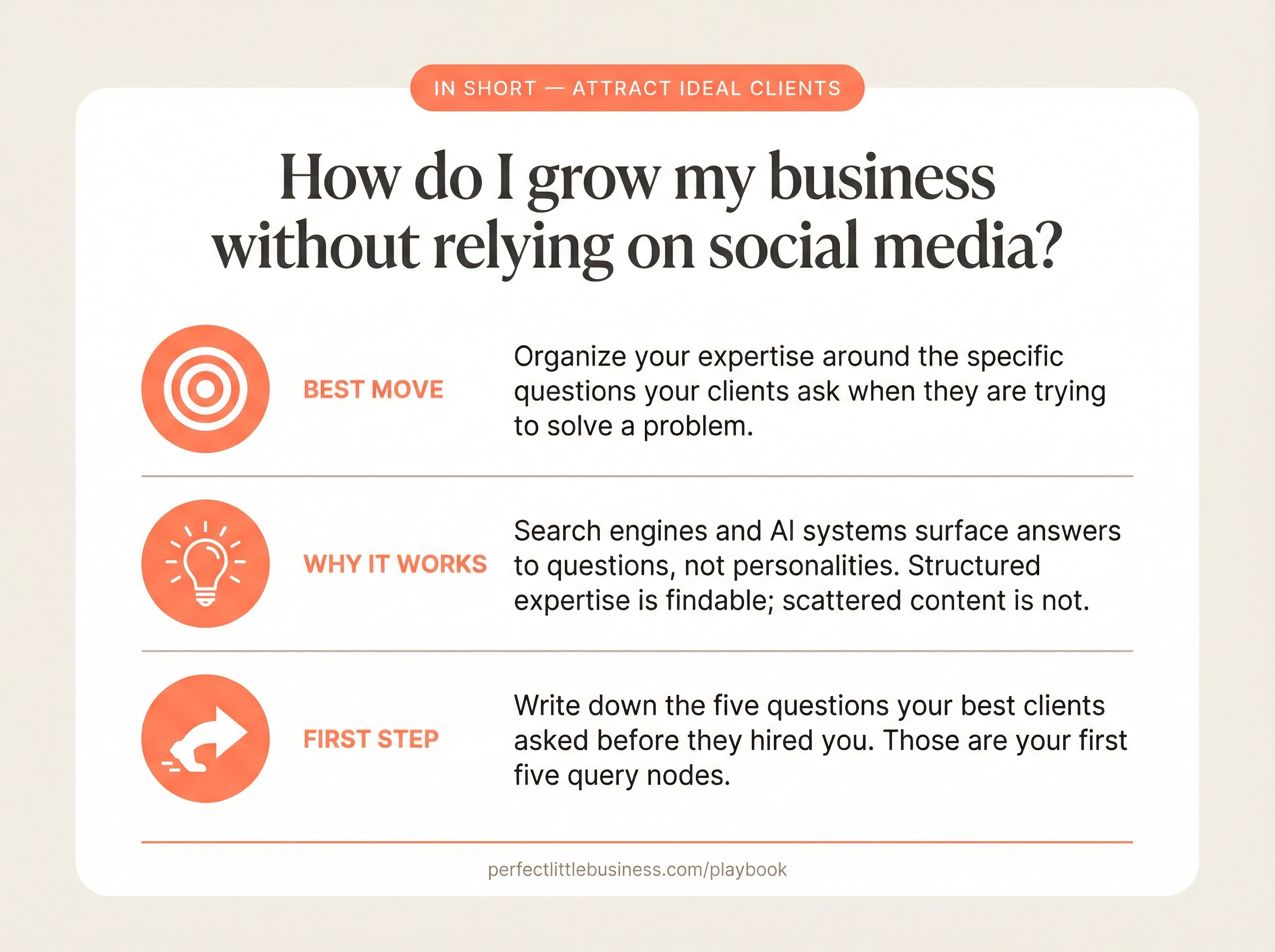
- Business growth does not require constant social media performance.
- Clients usually search for answers to problems, not personalities to follow.
- Expertise becomes easier to discover when it is organized around real questions rather than scattered content.
- Clear, structured explanations create authority faster than high-volume posting.
- Social media visibility is rented; indexed expertise is owned.
- The goal is to make your expertise discoverable and recommendable, not just visible.

See how AI understands your expertise
The AI Alignment Reading reveals where you are visible, where you are missing, and what to fix first.
Get Your AI Alignment ReadingIf I'm not relying on social media, where do new clients actually come from?
Most clients begin their search for help by asking a question. This might happen through Google, through AI tools, or through conversations with peers. In each case, the process starts with a problem: Why isn't my business growing? How do I attract better clients? What should I change about my strategy? When your expertise clearly answers these kinds of questions, people who are already looking for solutions can find your work. Instead of trying to create attention, you become visible when someone is actively seeking help.
What kind of marketing actually works for experts who don't want to be influencers?
Experts tend to grow faster when their marketing focuses on clarity rather than performance. This usually means explaining ideas that clients struggle to understand. The more clearly you articulate the problems you solve — and the thinking behind your solutions — the easier it becomes for people to recognize your authority. This type of visibility compounds over time because explanations remain useful long after they are published, unlike social media posts that disappear within hours.
How do I turn my expertise into something people can actually discover online?
The most effective approach is to organize your expertise around the questions your clients repeatedly ask. For example: problems they struggle to diagnose, decisions they are trying to make, or misconceptions they often have. When your ideas address these questions directly, they become much easier for search engines and AI systems to connect to the people asking them. Instead of scattered posts, you create a structured body of knowledge that explains your field.
What does it mean to structure expertise so AI and search engines understand it?
AI systems increasingly help people find answers to complex questions. They analyze large amounts of information and prioritize sources that clearly explain ideas. Experts who are easiest to surface usually have clear definitions of key ideas, explanations of how concepts connect, consistent terminology across their work, and credible references and examples. This structure makes it easier for machines — and humans — to understand when your expertise is relevant.
If I stop focusing on posting constantly, what should I focus on instead?
Focus on clarity and structure. Ask yourself: What problems do my clients struggle to articulate? What decisions are they trying to make? What misconceptions slow them down? Then create clear explanations that help them understand those issues. When your work consistently answers important questions in your field, it becomes easier for people to find you when they need help.
Most experts who feel stuck assume they have a marketing problem. They do not. They have a visibility architecture problem — their expertise is real, but it is not organized in a way that surfaces when the right people are looking for it.[4] A marketing problem is fixed by a better message. A visibility problem is fixed by better structure: publishing your answers on your own website, organized around the real questions your clients ask, indexed by search engines, and legible to AI systems.[1]
The authority directory is the most direct implementation of this idea. Each page answers one specific question your ideal client is searching for. The pages accumulate into a body of expertise that compounds over time — unlike a social media feed, which resets with every post. You own it, it works while you sleep, and it makes every referral more effective because the first thing a referred prospect does is search for you online.[2]
This is exactly what we help our clients do at Perfect Little Business.
- [1]OpenAI — Research on large language models and retrieval systems
- [2]Google Search Central — Documentation on structured content and helpful content signals
- [3]Content Marketing Institute — B2B Content Marketing Research
- [4]Davenport, T. & Mittal, N. (2022). All-in on AI. Harvard Business Review Press.

Founder, Perfect Little Business
Cindy Anne Molchany is the founder of Perfect Little Business. Since 2015, she has designed and built over 70 online programs for clients that have collectively generated more than $100 million in revenue. She helps established expert founders build intelligent, human-first businesses that attract ideal clients, command authority, and create leverage — without performing for algorithms or chasing endless scale.