Visibility and discoverability are not the same thing, and confusing them is one of the most expensive mistakes an expert business can make.
Visibility is a reach metric — impressions, followers, views, likes. It measures how many people saw something. Discoverability is an intent metric — it measures whether the right person found you at the moment they were actively looking for help.[1] An expert with ten thousand followers and no structured answers to client questions is highly visible and nearly undiscoverable. An expert with a modest website and five well-structured pages answering real client questions is quietly discoverable every day.[2]
The practical difference is this: visibility requires you to keep performing to stay relevant. Discoverability compounds. Every page you publish that answers a real question your clients search for continues working without you. The goal for an expert business is not to be seen by everyone — it is to be found by the right person at the exact moment they need what you offer.
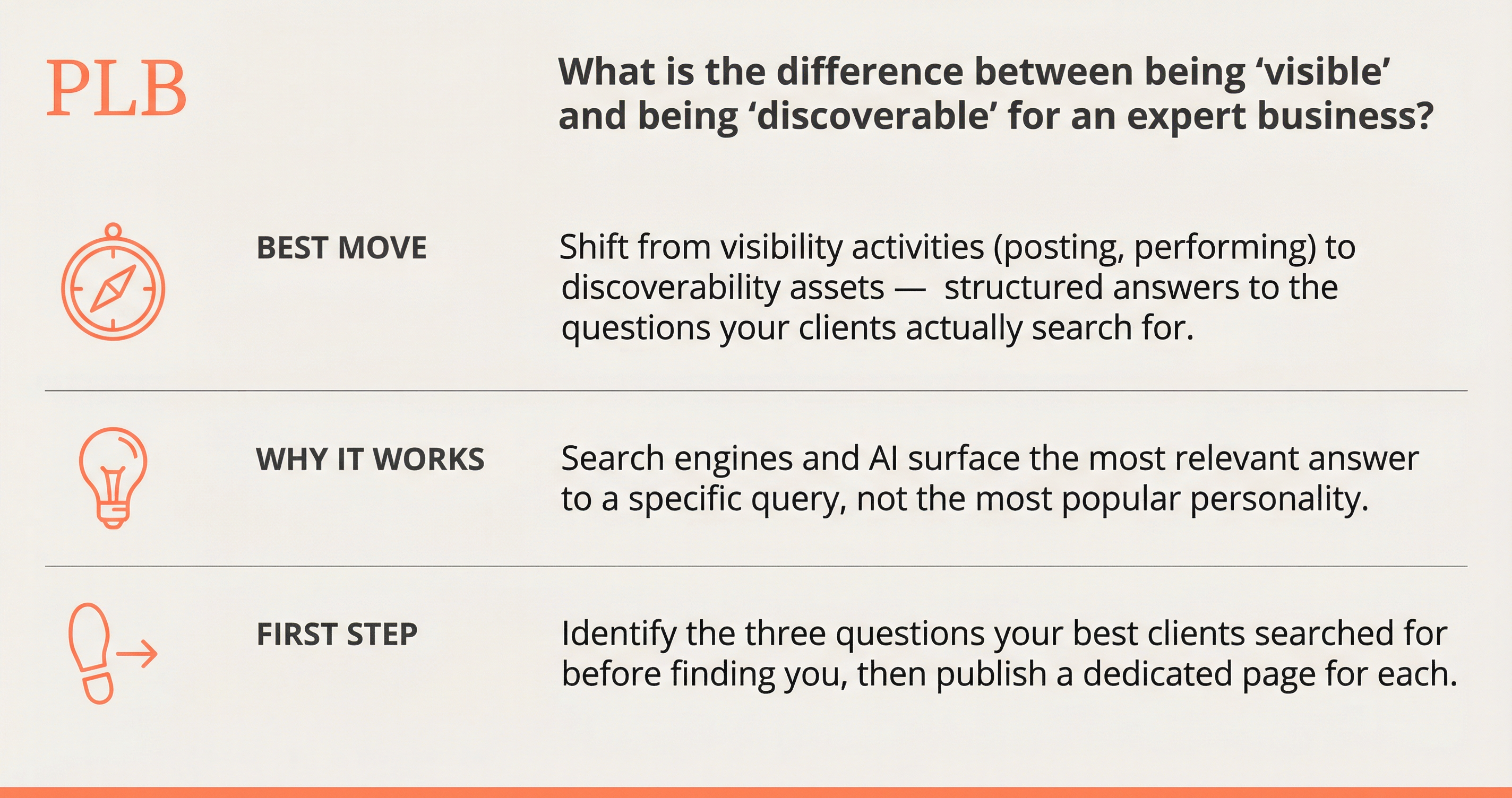
- Visibility measures reach; discoverability measures intent-matching.
- High visibility with low discoverability is common among experts who invest heavily in social media but have no structured knowledge assets.
- AI search systems (ChatGPT, Perplexity, Google AI Overviews) are discovery engines, not visibility engines — they surface answers, not personalities.
- Discoverability compounds over time; visibility resets with every post.
- Expert businesses win on discoverability because their ideal clients are searching for answers to specific problems, not browsing feeds.
- The shift from visibility to discoverability is a structural change, not a content volume change.
See how AI understands your expertise
The AI Alignment Reading reveals where you are visible, where you are missing, and what to fix first.
Get Your AI Alignment ReadingWhy do AI search tools favor discoverable experts over visible ones?
AI systems like ChatGPT and Perplexity are built to answer a specific question as accurately as possible — not to surface popular accounts or reward consistent posting. When someone asks an AI for help with a specific problem, the system scans for the clearest, most structured answer to that exact question. An expert who has published a dedicated page answering that question — with a specific title, a direct opening, and credible sources — is far more likely to be cited than an expert with 50,000 followers whose content is organized around topics, opinions, and engagement hooks. The mechanism is intent-matching, not popularity-matching. Visibility tells a platform how many people reacted; discoverability tells a search system how well your content answers a specific question. In AI-mediated search, only the second metric matters.
Can I be both visible and discoverable at the same time?
Yes — but they require different assets, and most experts only build one. Visibility is built through consistent presence on platforms: posting, engaging, showing up in feeds. Discoverability is built through structured knowledge assets on your own website — pages that answer specific questions, organized into a coherent hierarchy. The two can reinforce each other: a visible expert who also has a discoverable knowledge base gets the best of both. When you share a link to a well-structured page rather than a hot take, you're building visibility on the platform and discoverability on your own domain simultaneously. The mistake is investing entirely in visibility and assuming discoverability will follow. It won't — because discoverability requires a different kind of asset, built in a different place, organized around a different logic.
How do I know if my business has a visibility problem or a discoverability problem?
The diagnostic is simple: type the core problem you solve into Google or ChatGPT and see what comes up. If your ideas don't appear — even though you've been publishing for years — you have a discoverability problem, not a visibility problem. The second test is to look at where your best clients actually came from. If they came from referrals or from finding a specific piece of your thinking, your discoverability is working in limited ways. If they came primarily from your social media presence, you may have visibility without discoverability — which means your business is dependent on a channel you don't own and can't compound. A third signal: if potential clients arrive at discovery calls still needing to be convinced of your expertise, they haven't found your structured thinking before the call. That's a discoverability gap.
What does a discoverable expert business actually look like in practice?
A discoverable expert business has a structured body of knowledge on its own website, organized around the real questions its ideal clients ask. Each page answers one specific question — clearly, completely, with a direct opening paragraph that could stand alone as the answer. The pages are interconnected: a page on discoverability links to a page on visibility architecture, which links to a page on question-based content. The pages reference credible sources and use consistent terminology. When someone searches for help with the problem the expert solves — whether on Google, ChatGPT, or Perplexity — one or more of those pages appears in the results. The expert doesn't need to be online for this to happen. The structure does the work. The Playbook is an example of this model: every page answers one real question, the pages are organized into a hierarchy, and the whole thing compounds over time.
Is discoverability only relevant for Google, or does it apply to AI tools too?
It applies to every intent-based search system — Google, Bing, ChatGPT, Perplexity, Claude, and any AI assistant that retrieves information to answer questions. In fact, AI search tools may reward discoverability more aggressively than traditional search, because they are explicitly trying to surface the single best answer to a specific question rather than a ranked list of options. A well-structured, question-based page that answers a query directly is exactly what these systems are looking for. The practical implication is that the shift toward AI-mediated search makes discoverability more valuable, not less — and makes the investment in a structured knowledge base more durable than any social media strategy. Experts who build for discoverability now are positioning themselves for both the current and the emerging search landscape.
Most expert businesses are invisible not because their work is weak, but because their expertise isn't organized in a way that surfaces when the right people are looking for it.[3] The shift from visibility to discoverability is not a marketing tactic — it is an architectural decision. It means choosing to invest in owned, structured, compounding assets instead of rented, performance-dependent, ephemeral ones.
The Playbook is a direct implementation of this idea. Every page answers one specific question an expert founder might ask. The pages accumulate into a body of expertise that is findable by search engines, citable by AI systems, and useful to potential clients at the exact moment they need it.[1] You do not need to be online for it to work.
This is exactly what we help our clients do at Perfect Little Business.

Founder, Perfect Little Business
Cindy Anne Molchany is the founder of Perfect Little Business. Since 2015, she has designed and built over 70 online programs for clients that have collectively generated more than $100 million in revenue. She helps established expert founders build intelligent, human-first businesses that attract ideal clients, command authority, and create leverage — without performing for algorithms or chasing endless scale.