The video-course model dominated the 'passive income from expertise' conversation from roughly 2010 to 2020. The logic made sense at the time: record your knowledge once, sell it repeatedly, scale without trading time for money. But the model had a structural weakness that the AI era has exposed — video content is invisible to the systems that now drive discovery. AI search engines cannot watch a video. They read text, extract answers, and recommend sources. A video course is a black box to the systems that are increasingly determining what potential clients find when they search.
The alternative is not a compromise — it is an upgrade. A text-based, structured knowledge directory organized around the specific questions your ideal clients ask is more discoverable, faster to build, easier to update, and more useful to AI systems than any video course. It is also more useful to human readers who want a specific answer, not a 45-minute module. The Playbook is an example of this model: structured, question-driven, and organized so that both humans and AI systems can find exactly what they need.
AI dramatically reduces the production cost of building this kind of asset. You provide the judgment — the frameworks, the answers, the context. AI helps you structure, draft, and organize. A knowledge directory that would have taken months to build manually can be built in weeks with AI assistance. The result is a product that compounds over time: every new question you answer, every new node you add, increases the surface area of your discoverability.
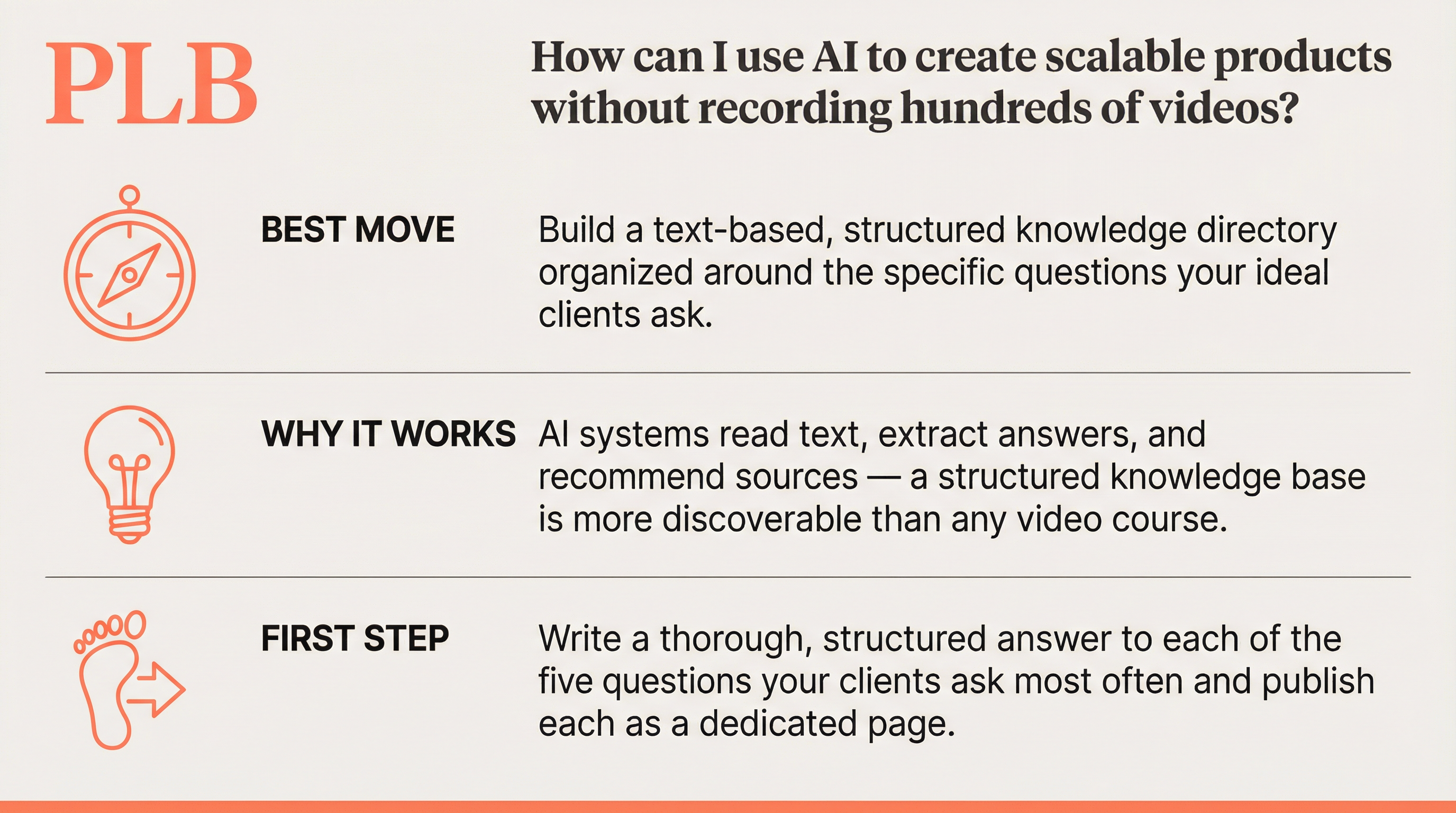
- AI systems cannot watch videos — they read text. Video courses are invisible to the systems that now drive discovery.
- A text-based, structured knowledge directory is more discoverable, faster to build, and easier to update than a video course.
- AI reduces the production cost of building knowledge assets — you provide the judgment, AI handles the production.
- The Playbook model (question-driven, structured, owned) is the most effective expert product format in the AI era.
- Every question you answer and publish increases your discoverability surface area — compounding over time.
- The first version of a knowledge directory can be built in days by answering the five questions your clients ask most.

See how AI understands your expertise
The AI Alignment Reading reveals where you are visible, where you are missing, and what to fix first.
Get Your AI Alignment ReadingWhat does it actually mean to 'productize' my expertise?
In the AI era, productizing expertise means building text-based, structured knowledge assets that AI systems can surface in response to relevant queries — and that human clients can access on demand without requiring your direct time. It is not primarily about courses or videos. It is about organizing your judgment into a form that works without you. The Playbook is an example of this: a productized version of PLB's expertise, organized so that both humans and AI can find exactly what they need. The first step is to identify the five questions your ideal clients ask most often before they hire you, write a thorough, structured answer to each one, and publish each as a dedicated page on your own website. That is a product. It compounds over time. Every new question you answer, every new page you add, increases the surface area of your discoverability and the depth of the trust you build before the first conversation.
I'm afraid that using AI will make my work generic and less valuable. Is that true?
AI makes generic work more generic and distinctive work more distinctive — and the distinction depends on what you use AI for. When you use AI to help you build a knowledge directory that reflects your specific frameworks, your specific answers, and your specific point of view, the result is distinctive because the judgment is yours. AI handles the production; you provide the thinking that makes the output valuable. The experts who are being devalued by AI are those whose value was always in production: writing, formatting, designing. The experts who are becoming more valuable are those who use AI for production and invest their freed time in making their judgment more visible and more structured. A text-based knowledge directory built with AI assistance is more discoverable, more durable, and more distinctive than a video course produced without it — because the discoverability comes from the structure and the specificity of the thinking, not from the production quality.
I'm so busy with client work that I have no time to build assets. How do I break that cycle?
AI dramatically reduces the time required to build knowledge assets — which is exactly what makes it the right tool for breaking the time-for-money trap. Instead of recording, editing, and producing video content, you write structured answers to the questions you already know. AI helps you draft, structure, and organize. A knowledge directory that would have taken months to build manually can be built in weeks. The time barrier that keeps most expert founders stuck in the trap is much lower than they assume when they're thinking about video production. The practical path: identify the five questions your clients ask most often, spend one focused session writing a structured answer to each with AI assistance, and publish each as a dedicated page. That is a viable first version of a knowledge directory — and it will be more discoverable than most expert websites that have been publishing for years.
AI is reshaping my industry. How do I evolve and stay in demand?
The experts who stay in demand are those who build structured knowledge assets that AI systems can surface and recommend — and who own the platform where those assets live. That means publishing on your own website, not on platforms that control your reach and your audience relationship. It means organizing your content around the questions your ideal clients ask, not around the topics you want to cover. It means using AI to help you build and maintain those assets efficiently, so that your knowledge base grows consistently without requiring unsustainable production effort. The experts who will struggle are those who continue to invest in video production and platform-dependent distribution in a search environment that increasingly favors text-based, owned, question-organized content. The shift is not about working harder — it is about building in the right format for the environment that now determines what potential clients find.
The shift from video to text as the primary format for scalable expert products is not a stylistic preference — it is a structural consequence of how AI-driven discovery works. When someone asks ChatGPT, Perplexity, or Google's AI Overview a question, the system looks for text-based sources it can read, extract from, and cite. A well-organized knowledge directory on your own website is exactly the kind of source these systems are looking for. A video course on a third-party platform is not. The experts who understand this shift and build accordingly will have a significant discoverability advantage over those who continue to invest in video production.
The practical implication is straightforward: start with text, organize around questions, and own the domain. Use AI to help you build faster and structure better. Publish on your own website, not on platforms that own the relationship with your audience. Update regularly, because freshness is a signal that both humans and AI systems reward. This is exactly what we help our clients do at Perfect Little Business.
This is exactly what we help our clients do at Perfect Little Business.

Founder, Perfect Little Business
Cindy Anne Molchany is the founder of Perfect Little Business. Since 2015, she has designed and built over 70 online programs for clients that have collectively generated more than $100 million in revenue. She helps established expert founders build intelligent, human-first businesses that attract ideal clients, command authority, and create leverage — without performing for algorithms or chasing endless scale.