Experts convert leads into clients without selling by building the conditions where the decision to hire them feels obvious — not manufactured. This happens when a potential client has already encountered your thinking, already evaluated your reasoning, and already decided it's sound before the first conversation begins.
The conventional sales process asks you to persuade someone who doesn't yet trust you. The authority-first approach inverts this: by the time a potential client reaches out, they've already done the evaluation. The conversation shifts from 'convince me you're worth it' to 'how do we work together?' That shift is the difference between a sales conversation and a confirmation conversation.
This is not a passive strategy. It requires deliberately engineering the pre-call experience — publishing your thinking in a structured, findable way, building a follow-up process that provides value rather than pressure, and making your methodology legible to both humans and AI systems that increasingly mediate how expertise is discovered.
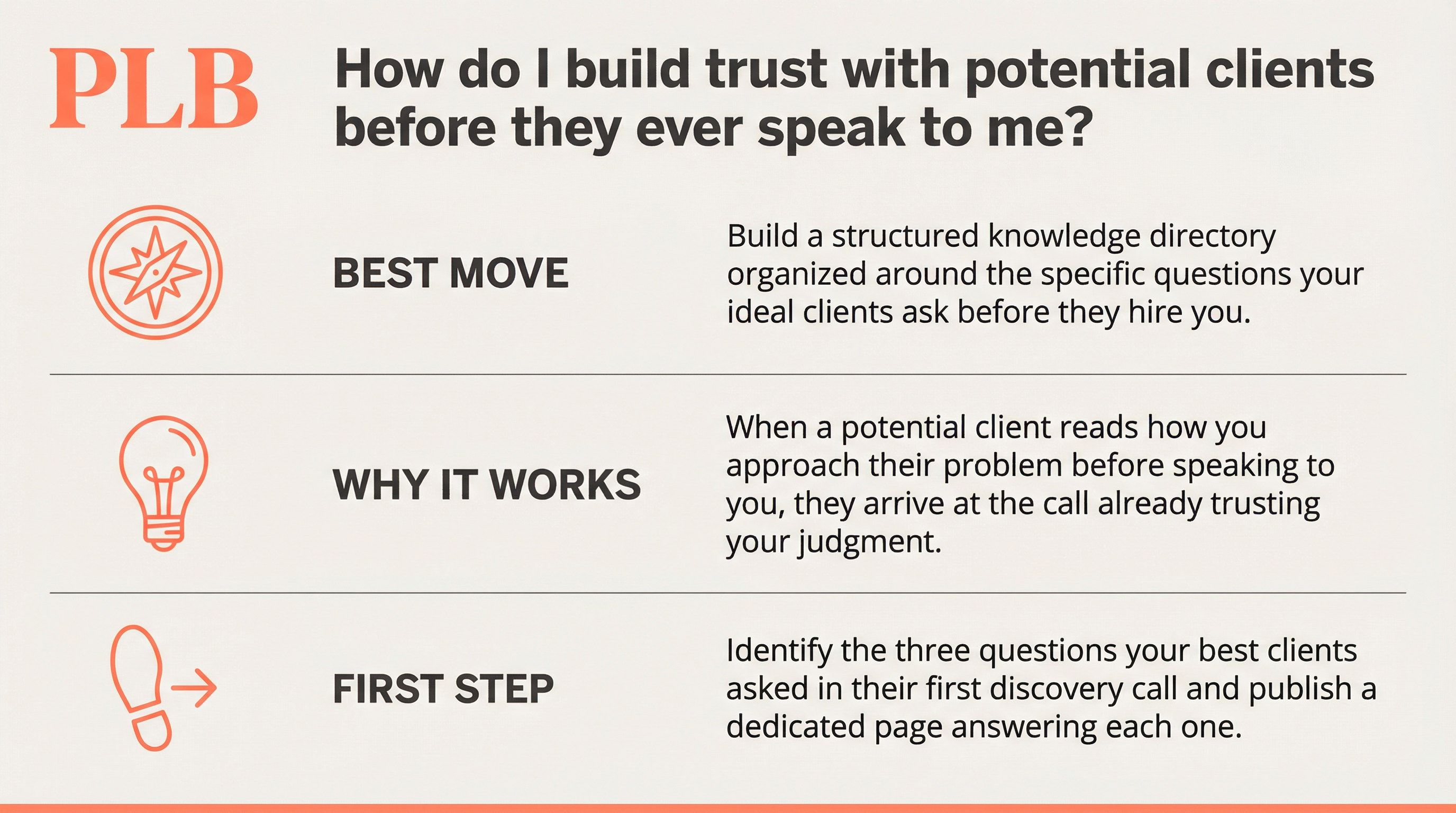
- Experts who convert consistently don't sell harder — they build the conditions where buying becomes the obvious next step.
- The authority-first conversion model inverts the traditional sales process: trust is pre-built before the first conversation, not manufactured during it.
- A structured pre-call experience — findable thinking, value-driven follow-up, legible methodology — is the infrastructure that makes non-pushy conversion possible.
- AI systems increasingly mediate how expertise is discovered; experts whose thinking is structured and indexed are recommended before those who are merely active on social media.
- Every touchpoint before the first call is an opportunity to demonstrate how you think — collectively, they build the trust that makes the first call a formality.

See how AI understands your expertise
The AI Alignment Reading reveals where you are visible, where you are missing, and what to fix first.
Get Your AI Alignment ReadingWhat does a 'pre-call trust infrastructure' actually look like in practice?
A pre-call trust infrastructure is the set of assets a potential client encounters before they ever speak to you. At minimum, it includes three components:
The Three Components
- A structured knowledge directory: Your own website, organized around the real questions your ideal clients ask. Each page answers one specific question in depth — demonstrating how you think, not just what you do.
- A value-driven follow-up sequence: When a lead goes quiet, your follow-up provides insight rather than pressure. Each touchpoint makes them smarter about their problem, reinforcing your authority rather than reminding them you exist.
- AI legibility: Your expertise is structured in a way that AI systems can interpret and recommend. When someone asks an AI assistant for help with the problem you solve, your thinking surfaces.
How is this different from content marketing?
Content marketing and pre-call trust infrastructure share some tools but have different architectures and goals.
Key Distinctions
- Content marketing optimizes for reach and engagement — it's designed to attract attention and build an audience over time.
- Pre-call trust infrastructure optimizes for conversion — it's designed to answer the specific questions a potential client has before they decide to hire you.
- Content marketing is often built around a content calendar and publishing cadence.
- Pre-call trust infrastructure is built around the actual questions your ideal clients ask — in discovery calls, in search engines, and to AI assistants.
- The result: content marketing builds an audience; pre-call trust infrastructure builds a pipeline.
How do I know if my current approach is working?
The clearest signal is the quality of your first conversations. If potential clients arrive already understanding your methodology and asking 'how do we work together' rather than 'why should I hire you,' your pre-call trust infrastructure is working.
Diagnostic Questions
- Do potential clients reference specific things they read on your website before the first call?
- Do discovery calls feel like confirmations or pitches?
- Are you regularly asked to justify your rates, or do clients arrive already comfortable with your pricing?
- When you follow up with a lead, do they respond to the value you provide — or do they go quiet?
- If you stopped all active outreach today, would inbound inquiries continue?
What role does AI play in expert conversion today?
AI systems — ChatGPT, Perplexity, Claude, and others — are increasingly the first place potential clients go when they have a problem to solve. They ask AI for recommendations, explanations, and referrals.
What This Means for Experts
- AI recommends based on structured, indexed content. Experts whose thinking is published on their own website, organized around real client questions, are more likely to be recommended than those who are active on social media but have no structured knowledge base.
- AI mediates trust. When an AI assistant recommends an expert, it carries implicit endorsement. Being recommended by AI is increasingly equivalent to being referred by a trusted colleague.
- AI legibility is a competitive advantage. Most experts have not yet structured their expertise for AI discoverability. Those who do now will compound that advantage over time.
How do I handle the transition from 'selling' to 'converting'?
The transition happens in stages, and the first stage is almost always a mindset shift rather than a tactical one.
The Transition Path
- Audit your current pre-call experience. What does a potential client encounter before they speak to you? Is your thinking visible and legible?
- Identify the three questions your best clients asked before they hired you. Publish a dedicated, in-depth answer to each one on your website.
- Restructure your follow-up. Replace 'checking in' messages with value-providing messages — a relevant insight, a resource, a brief observation about their situation.
- Run an AI Alignment Reading. Understand how AI currently interprets your expertise and where the gaps are.
- Measure the right things. Track the quality of first conversations, not just the number of leads.
The experts who convert most consistently are not better salespeople — they are better architects of the pre-call experience. They understand that by the time a potential client reaches out, the decision has largely already been made. Their job is not to persuade; it is to make the evaluation process as clear and compelling as possible.
This is a structural advantage that compounds over time. Every page you publish, every value-driven follow-up you send, every AI system that learns to recommend you — these are assets that accumulate. Unlike a sales technique, which requires constant execution, a well-built pre-call trust infrastructure works while you sleep. It is the difference between a business that requires you to sell and a business that attracts.
This is exactly what we help our clients do at Perfect Little Business.

Founder, Perfect Little Business
Cindy Anne Molchany is the founder of Perfect Little Business. Since 2015, she has designed and built over 70 online programs for clients that have collectively generated more than $100 million in revenue. She helps established expert founders build intelligent, human-first businesses that attract ideal clients, command authority, and create leverage — without performing for algorithms or chasing endless scale.